
Understanding How Power Imbalances Prevent Progress
For decades, disability services in the United States—and across the world—have been shaped by decision-making systems that exclude the very people they claim to serve. Two forces, tokenism and paternalism, continue to undermine progress, weaken accountability, and block structural change. This page explains why these practices persist, how they violate the spirit of major civil rights laws, and what a community-governed alternative looks like.
What Tokenism Means
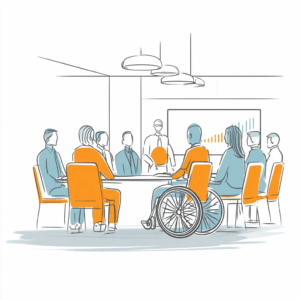
Tokenism occurs when disabled people are given symbolic roles without real influence over decisions, policies, or institutional direction. Examples include appointing a single disabled person to a board dominated by non-disabled members, creating advisory committees with no binding authority, inviting feedback without granting voting power, or using disabled people for appearances while ignoring their expertise. Tokenism creates an illusion of inclusion while preserving existing power structures.
What Paternalism Means
Paternalism is the practice of making decisions for disabled people—based on what non-disabled leaders believe is best—rather than trusting disabled people to define their own needs and priorities. In the 21st century, paternalism appears not only in services but also in the products and technologies organizations adopt.
Paternalism in services includes designing programs without consulting those who rely on them, implementing policies “for safety” without consent, assuming disabled people lack expertise, or prioritizing institutional convenience over autonomy. Paternalism in products includes building or purchasing software or hardware without accessibility testing, redesigning websites without blind or DeafBlind involvement, adopting technologies incompatible with assistive tools, investing in “accessibility solutions” that fail in practice, or relying on vendors who promise accessibility without lived‑experience validation. Product paternalism has become one of the largest sources of modern inaccessibility.
How Paternalism Spreads Across Systems
Paternalistic practices rarely stay within a single organization. They ripple outward and influence government agencies, corporations, and policymakers who mistakenly believe they are receiving authentic community input.
Government agencies rely on the wrong voices, shaping policies and regulations based on filtered perspectives. Corporations adopt inadequate accessibility standards, believing their products are compliant when they fail real-world tests. Paternalistic nonprofits become gatekeepers who control information and silence dissent. Policymakers assume consultation has occurred when it has not, burying the need for meaningful reform.
Another widespread form of modern paternalism occurs when nonprofits “bring the community” to meet with policymakers or technology companies. Although these meetings appear participatory, the dialogue is often tightly controlled by the nonprofit’s leadership or staff, who set the agenda, select the speakers, and intervene when comments diverge from the organization’s preferred narrative. The institution prioritizes preserving its relationships over centering community needs.
In many cases, the “consumers” presented in such meetings are actually employees of the nonprofit. These individuals cannot speak freely about accessibility barriers or organizational shortcomings without fear of retaliation or professional consequences. Policymakers and tech leaders leave these meetings believing they have heard genuine feedback, when in reality they have received a curated narrative that protects institutional interests rather than community truth.
This ripple effect extends globally. Because American accessibility standards influence international policy, paternalism in U.S. nonprofits can shape inaccessible design norms around the world. The result is that well-meaning organizations often find themselves scrambling to close gaps in accessibility once lived-experience tests are done or compliance is scrutinized.
Impact on Big Tech
The consequences of paternalism are especially visible in the technology sector. Big Tech companies frequently consult disability nonprofits believing they are receiving authentic, community‑driven guidance. But when those nonprofits operate under paternalistic governance—where disabled people lack real authority—the feedback tech companies receive is filtered, incomplete, or shaped by institutional convenience rather than lived reality.
As a result, major platforms integrate “accessibility solutions” that look compliant on paper yet fail in everyday use. This disconnect is most acute for DeafBlind people, whose needs are often misunderstood, minimized, or entirely overlooked when decision‑making lacks true lived‑experience leadership. Technologies may pass automated tests, satisfy vendor claims, or meet minimal regulatory checklists, yet remain functionally inaccessible: tactile access is incomplete, haptic feedback is poorly implemented, and critical workflows break when tested by real users.
In short, paternalism misleads Big Tech into adopting accessibility approaches that do not reflect the lived realities of disabled people. Without governance structures that center real experience, technology companies risk building products that expand digital participation for some while deepening exclusion for others. Meaningful accessibility requires meaningful leadership—not symbolic involvement, but structural power in design, testing, and decision-making.
Why Tokenism and Paternalism Block Progress
These practices silence lived experience, weaken accountability, and create unresponsive institutions. They lead to inaccessible programs, stale ideas, and broken innovation pipelines. They damage community trust and prevent meaningful reform. Progress is impossible when decisions are made by those least affected by their consequences.
Why These Practices Contradict Disability Civil Rights Laws
Civil rights laws such as the ADA, Section 504, and the CVAA were built on the principle that disabled people must have equal access, opportunity, and participation. Tokenism and paternalism contradict these values by denying meaningful participation, undermining autonomy, and recreating structures that these laws were designed to dismantle.
Persistent Gaps in Accessibility
Despite decades of legal and technological progress, major gaps remain. Digital platforms are still inaccessible. Nonprofits replicate outdated power structures. Blind and DeafBlind perspectives remain underrepresented. Technologies are deployed without lived-experience review. Accessibility is often treated as optional rather than essential. These failures persist not because solutions are unknown, but because disabled leadership is missing from the rooms where decisions are made.
A Community-Governed Alternative
Bay Area Access offers a structural alternative. Our model is built on majority-disabled governance, enforceable community oversight, and lived-experience leadership. A permanent Community Advisory Council holds real authority over policy, leadership, and accountability. Transparency, open meetings, and anti-retaliation protections ensure trust. Innovation is driven by those who rely on accessibility—not those who merely observe it. This model is designed to scale globally, demonstrating how governance grounded in lived experience can strengthen accessibility worldwide.
Help Implement the Solution
Tokenism and paternalism have shaped disability services for generations, but they are not inevitable. The solutions exist: majority-disabled governance, lived-experience leadership, enforceable community oversight, and transparent structures that prevent institutional gatekeeping. Bay Area Access was created to put these solutions into practice—not theoretically, but structurally.
If you believe disabled people should hold real power, if you believe accessibility must be guided by lived experience, and if you believe we can build a model strong enough to scale globally, then you can help implement the solution.
Your support strengthens the governance model, community protections, and innovation framework needed to replace symbolic inclusion with real authority. Together, we can end tokenism and paternalism and build a future where accessibility is a shared commitment—not a charity, not an afterthought, but a human responsibility. Support the solution today.